In the neighbourhoods of North West London, Willesden Green, Queen’s Park and Kensal Rise, a quieter kind of innovation has been taking place.
Not driven by scale at all costs or aggressive growth targets, but by a simple question: how can local delivery work better for people, businesses and the places they live?
Streetly began as a pedal powered delivery service rooted in community and sustainability. Today, it is a fully fledged digital platform that brings together independent merchants, local customers and zero emission couriers through technology designed specifically for hyperlocal logistics.
White Rabbit Foundry partnered with eStreet Services to help turn that vision into a scalable, resilient digital ecosystem, without losing the values that made the idea compelling in the first place.
A local idea with national relevance
Streetly’s origins are deeply local.
For Graham Norton, founder of eStreet Services, Willesden Green was not just a test market, it was home. The area’s independent shops, diverse community and growing focus on sustainability made it the ideal place to explore a different model of last mile delivery.
“We were operating close to my house, and I was ready to jump on a bike and deliver things myself if needed,” Graham recalls.
That hands on approach aligned with a broader opportunity. Funding through Brent Council, linked to the DEFRA supported Clean Air Villages initiative, helped anchor sustainability at the core of Streetly’s model from day one. Zero emission delivery was not an add on. It was the foundation.
From proof of concept to platform
Like many early stage ideas, Streetly started with a pragmatic MVP.
An initial Shopify setup allowed the team to test demand, work with early merchants and understand the operational realities of local delivery. It worked well enough to validate the concept, but it quickly became clear that off the shelf tooling would not support the complexity of what Streetly needed to become.
Hyperlocal delivery is fundamentally different from traditional e-commerce. It involves multiple merchants, overlapping delivery windows, local routing constraints and real time coordination between customers, vendors and couriers.
Streetly needed a platform built around those realities, not forced into them. That is where White Rabbit Foundry came in.
Designing a system that could grow without losing its roots
White Rabbit Foundry worked closely with eStreet Services to design and build a bespoke digital ecosystem that could scale sustainably while remaining grounded in local context.
Rather than focusing on a single app or interface, the work centred on building a coherent system made up of three tightly integrated experiences:
A customer experience that makes discovering and ordering from local businesses effortless;
A merchant experience that supports daily operations without adding administrative burden;
An internal and courier experience that enables efficient, fair and transparent delivery operations.
Behind these experiences sits a robust Google Cloud Platform backend, designed to support complex logistics, multi basket orders, live dispatch and operational visibility.
Alongside the core platform, White Rabbit Foundry also developed Streamlit based reporting and operational dashboards, giving the Streetly team real time insight into performance, delivery efficiency and merchant activity.
The goal was not just to make delivery work, but to make it visible, measurable and continuously improvable.
Built for people, supported by technology
Streetly’s platform is intentionally human in how it feels, but serious in how it works.
Customers can sign up quickly, discover nearby merchants, place orders and track deliveries in real time. Merchant partners benefit from intuitive onboarding, clear order management and dashboards that reflect what actually matters day to day. Cyclist couriers receive optimised routes, clear delivery checkpoints and realistic time estimates.
Each experience is different, but they are designed to flow together seamlessly. That cohesion is what allows Streetly to feel simple on the surface while handling significant complexity underneath.
A local success story, Daisy Chain Flowers
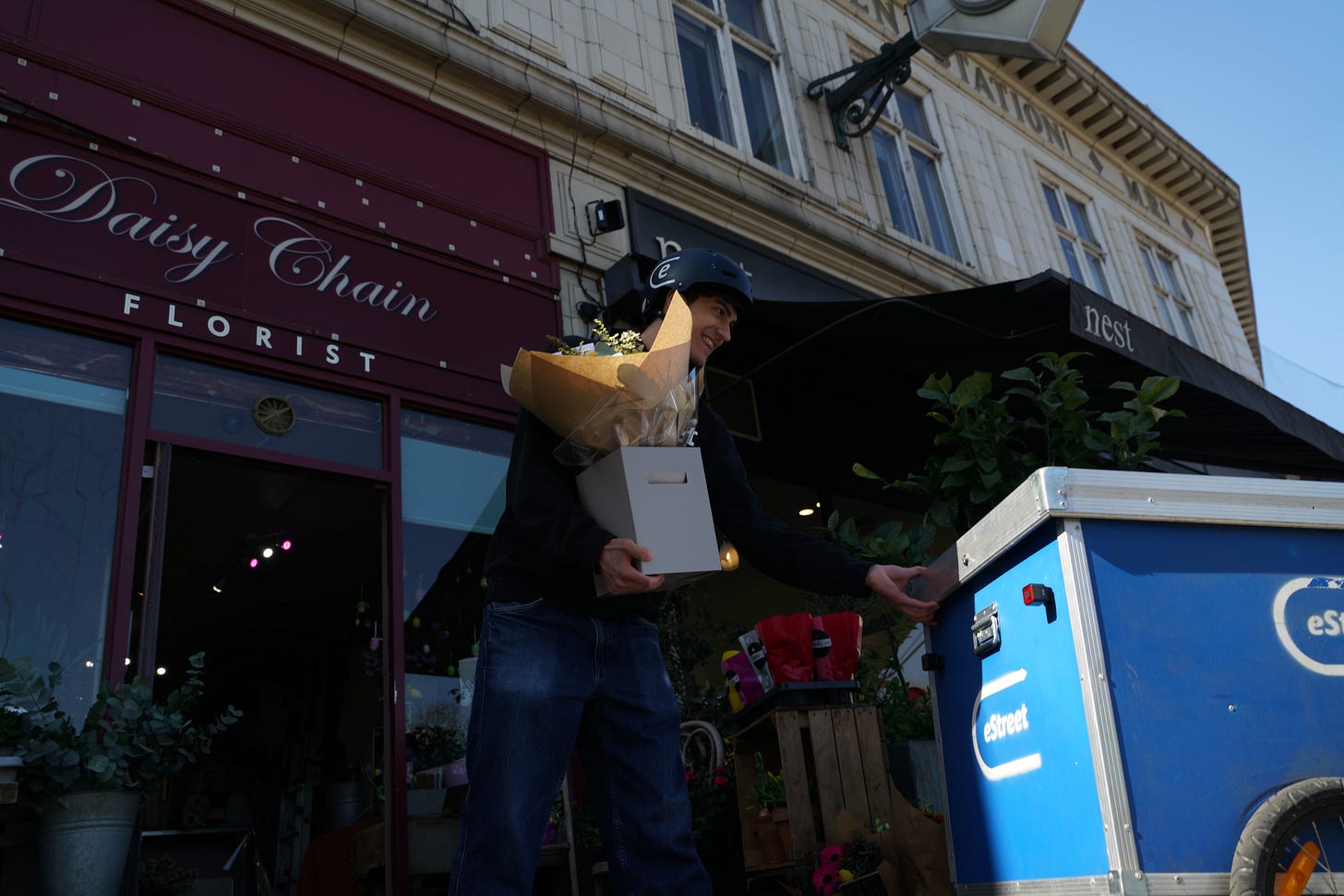
One of Streetly’s earliest and most visible successes came through Daisy Chain, a florist based in Willesden Green.
“They joined us during the Clean Air Villages campaign,” Graham explains. “At first, we were delivering a few days a week. Now it’s daily, and customers can order directly through Streetly.”
For Daisy Chain, the platform did more than increase orders. It allowed the business to grow without sacrificing its identity or values. Deliveries remained local. Customer relationships stayed direct. Sustainability was built in rather than bolted on.
It is a clear example of how thoughtful digital infrastructure can strengthen, rather than replace, local commerce.
Brand and experience, designed to feel familiar
Streetly’s brand was designed to feel recognisably British and unmistakably local.
The name itself reflects movement and place. The colour palette draws inspiration from the surrounding area, from the red of local tube lines to the green of nearby parks. The visual identity is modern without feeling corporate, familiar without being nostalgic.
As Vydimantas Baltrusaitis (Vydi), Director of White Rabbit Foundry and Fractional CTO for eStreet Services, puts it:
“It needed to feel like your London, not a generic tech startup version of it. That sense of familiarity matters when you’re asking people to trust a new platform.”
Scaling carefully, learning continuously
Streetly’s rollout was deliberately focused.
By launching and refining the platform in a single area first, the team could test assumptions, gather feedback and improve the experience in real world conditions. Route logic, UX details and operational workflows were all shaped by lived use rather than theoretical planning.
This approach allowed Streetly to build confidence before expansion, ensuring the model works in practice, not just on paper.
Building better search for a hyperlocal marketplace
One of the most complex challenges Streetly faced was search.
Unlike a traditional e commerce store, Streetly brings together multiple vendors, each managing their own products, while presenting a unified experience to customers. Search needed to understand not just what someone was looking for, but where they were and what made sense locally.
White Rabbit Foundry worked with the Streetly team to rebuild search logic from the ground up.
Search results are location aware, prioritising nearby vendors using geo distance calculations. Ambiguous queries are handled intelligently, so a search for “rose” can surface flowers or wine depending on context and filtering. Fuzzy matching ensures small spelling errors do not lead to dead ends.
The system balances exact matching with flexibility, and is designed to evolve towards more personalised relevance as user behaviour data grows.
Crucially, this logic was built bespoke, rather than relying on heavyweight off the shelf solutions that struggled with hyperlocal weighting, cost control or adaptability.
Why bespoke mattered
Off the shelf tools were evaluated.
Some were powerful but expensive at scale. Others lacked the flexibility needed for hyperlocal relevance. Hybrid approaches introduced complexity without solving core problems.
By building search logic in house, using Firestore, caching layers and custom scoring, Streetly gained full control over how relevance is defined and refined. This made it easier to iterate quickly, respond to merchant needs and adapt as the marketplace evolves.
Lessons from building Streetly
Streetly’s journey offers broader lessons for digital product teams and founders.
Hyperlocal marketplaces behave differently from global platforms. Search, logistics and operations must reflect place, not just scale.
Simple, adaptable systems often outperform complex frameworks in fast moving environments.
Operational insight matters as much as customer experience. Visibility enables better decisions.
And perhaps most importantly, technology works best when it amplifies a clear mission rather than trying to define one.
What comes next
Streetly continues to evolve.
Future developments include more personalised search relevance, richer filtering options and real time product indexing. Each improvement is guided by the same principle that shaped the platform from the start, staying local, staying sustainable and staying useful.
Why Streetly matters now
In a delivery landscape dominated by faceless platforms and fuel powered vans, Streetly offers a different path.
It shows that independent businesses deserve thoughtful technology. That sustainability and convenience can coexist. And that digital platforms do not have to erase community to succeed.
Streetly is not just delivering parcels. It is delivering a model for how local commerce can thrive in a digital world.
To learn more, visit https://streetly.uk/ and explore what hyperlocal delivery can look like when technology works with communities, not over them.